At a glance
- B2B data describes businesses and the people in them, structured for a specific commercial purpose.
- Company identity is the foundation; contact and signal data are only as good as the entity they are attached to.
- Reliable data shows its source and status, and named business contacts remain personal data.
B2B data, in plain terms
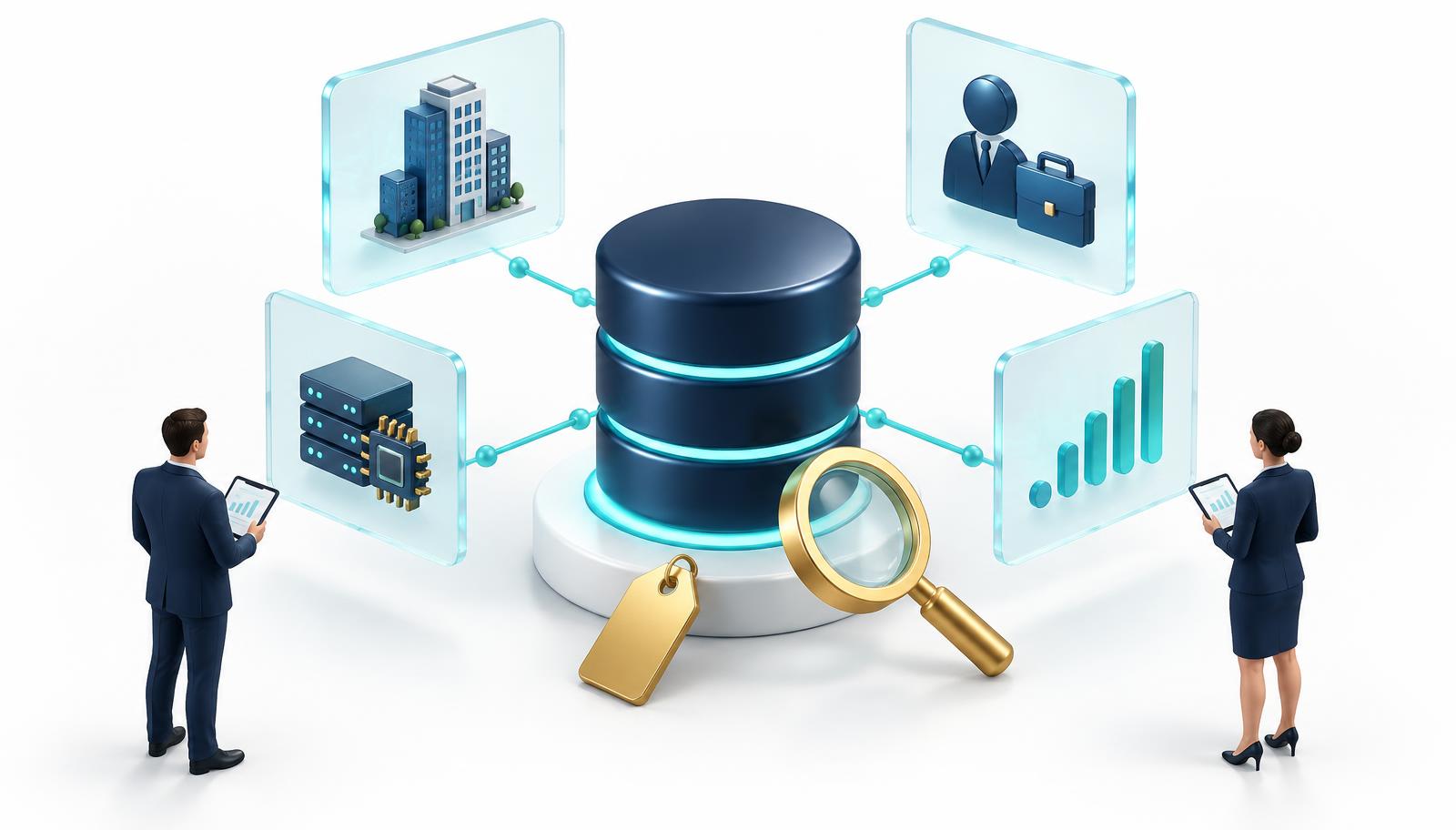
B2B data is information about businesses and the people who work in them, collected so that another business can sell to, serve, research or partner with them. A single record might describe a company's legal name, website, location, industry and size, together with a named person, their role and a way to contact them at work.
The definition sounds simple, but the useful part is the purpose behind it. A marketing team wants to know which companies fit a campaign. A sales team wants to know who owns a problem. A finance or compliance team wants to know that a supplier really exists. The same company can need quite different fields depending on which of those questions you are answering.
Company data is the foundation of every record
Firmographic data describes the organisation itself: registered name, trading name, domain, headquarters and site locations, industry classification, employee range, revenue band where it is published, ownership and corporate parent. It is the layer most other information hangs from, so mistakes here spread. Attach a contact to the wrong subsidiary and every later step inherits the error.
Good company data separates legal identity from how people talk about a business. A group might trade under one brand while invoices and contracts sit with differently named entities in each country. Recording both, along with a clear parent-child relationship, saves arguments later about territories, duplicate accounts and which office a campaign should reach.
Contact and role data tells you who, not just where
Contact data covers the people: name, job title, department, seniority, work email, direct or switchboard phone and a professional profile where appropriate. Titles alone are surprisingly unreliable. “Head of Data” can mean a technical lead in one company and a commercial role in another, so researchers often add a normalised function and seniority next to the original wording.
Role data is also the part that changes fastest. People move jobs, get promoted and change responsibilities without updating every public source. A contact record therefore needs a sense of time: when was this person last confirmed in this role, and from what kind of source? Without that, a list can look complete while quietly drifting out of date.
Technographic, intent and event signals add context
Beyond the core record sit signals that suggest timing or fit. Technographic data describes the software and infrastructure a company appears to use. Intent signals suggest a business is researching a topic. Event data shows which companies exhibit, sponsor or attend particular shows. Hiring activity, new sites and regulatory changes can play a similar role.
These signals are useful precisely because they are indirect, and that is also their weakness. A job advert mentioning a platform does not prove a purchase; a visit to a pricing page does not identify a buyer. Treat signals as reasons to look more closely, then confirm the facts that matter before they drive a decision.
Make your next data project easier to review.
B2B Database BuildingWhere B2B data comes from
First-party data is what your organisation collects directly: CRM records, enquiries, customers, event registrations and support history. Third-party data comes from providers who compile records from many sources. Between the two sits researched data, built for a specific brief from company registries, websites, annual reports, trade directories, association member lists and public professional profiles.
Each source has a different strength. Registries are good for legal existence and status but weak on people. Company websites describe products and leadership but rarely headcount. Purchased databases offer scale but vary in freshness by market. Asking where each field came from is one of the quickest ways to judge whether a dataset will hold up.
How sales, marketing and operations use B2B data
Most teams use B2B data for a handful of recurring jobs: defining and sizing a target market, building account and contact lists, routing leads to the right owner, personalising campaigns, enriching incomplete CRM records and removing companies that should not be contacted. B2B database marketing simply means running those campaigns from a structured, maintained dataset rather than one-off lists.
Analysts also mine larger datasets for patterns: which industries convert, which company sizes churn, which job functions respond. That kind of B2B data mining only works when the underlying fields are consistent. If one record says “IT”, another “Information Technology” and a third leaves the field blank, the pattern you find may be about data entry rather than customers.
What makes B2B data reliable
Reliability comes down to a few questions that apply to almost every field. Is it accurate for the right entity? Is it current enough for the decision? Is it complete for the fields you actually need? Is it consistent in format across records? And can someone see the source or verification status behind it? A dataset that answers those questions honestly is more useful than one that simply fills every column.
Validation checks values against rules and evidence, such as confirming a domain resolves, a company is still active or an email address is deliverable. Governance decides who may change which fields and how disagreements are resolved. Quality is the result of both, maintained over time rather than achieved once during an import.
Business contacts are still personal data
It is easy to assume that work information is exempt from privacy rules. In the UK and EU it generally is not: a named person's work email and job title can identify them, so data protection law applies. Teams typically need a lawful basis for processing, must tell people how their data is used and have to honour objections and opt-outs promptly.
Electronic marketing rules add further conditions that differ between countries and between corporate and individual subscribers. This is an area for your own legal advice rather than assumptions. Practically, keep a record of where each contact came from, maintain a suppression list that every campaign checks, and avoid collecting fields you have no clear use for.
Deciding whether to build, buy or research
If your market is well covered by an established provider and your fields are standard, buying access can be efficient. If the market is niche, international or poorly represented, or you need specific roles and verified status, researched data built to your criteria is often the better fit. Many teams combine both, using researchers to fill gaps a platform cannot.
Whichever route you choose, start with a written brief: the companies that qualify, the roles you need, the required fields, how they will be verified and how the file will be delivered. Then test a sample against your own CRM before committing to volume. That small step answers more about quality than any feature list.
A practical comparison
| Check | Starting point | What to confirm |
|---|---|---|
| Company data | A name and a website | Legal entity, parent, location and status |
| Contact data | A title copied from a profile | Current role, function, seniority and last-checked date |
| Signals | A single activity treated as intent | Corroborated evidence before it drives outreach |
| Compliance | Assuming work details are exempt | Recorded source, lawful basis and suppression checks |
Frequently asked questions
What is the meaning of B2B data?
B2B data is information about businesses and their employees, such as company details, roles and work contact information, used by other businesses for sales, marketing, research and partnerships.
What are the main types of B2B data?
The common types are firmographic (company) data, contact and role data, technographic data, and signals such as intent, hiring or event participation. Many datasets combine several types in one record.
What is the difference between B2B and B2C data?
B2C data describes individual consumers and households. B2B data centres on organisations and the professional roles inside them, so company identity, structure and decision-making responsibility matter far more.
Is B2B contact data covered by GDPR?
Generally yes in the UK and EU, because a named person's work details can identify them. Take legal advice for your situation and keep clear records of sources, lawful basis and opt-outs.